
What is a Business License Number? How to Find and Get Yours

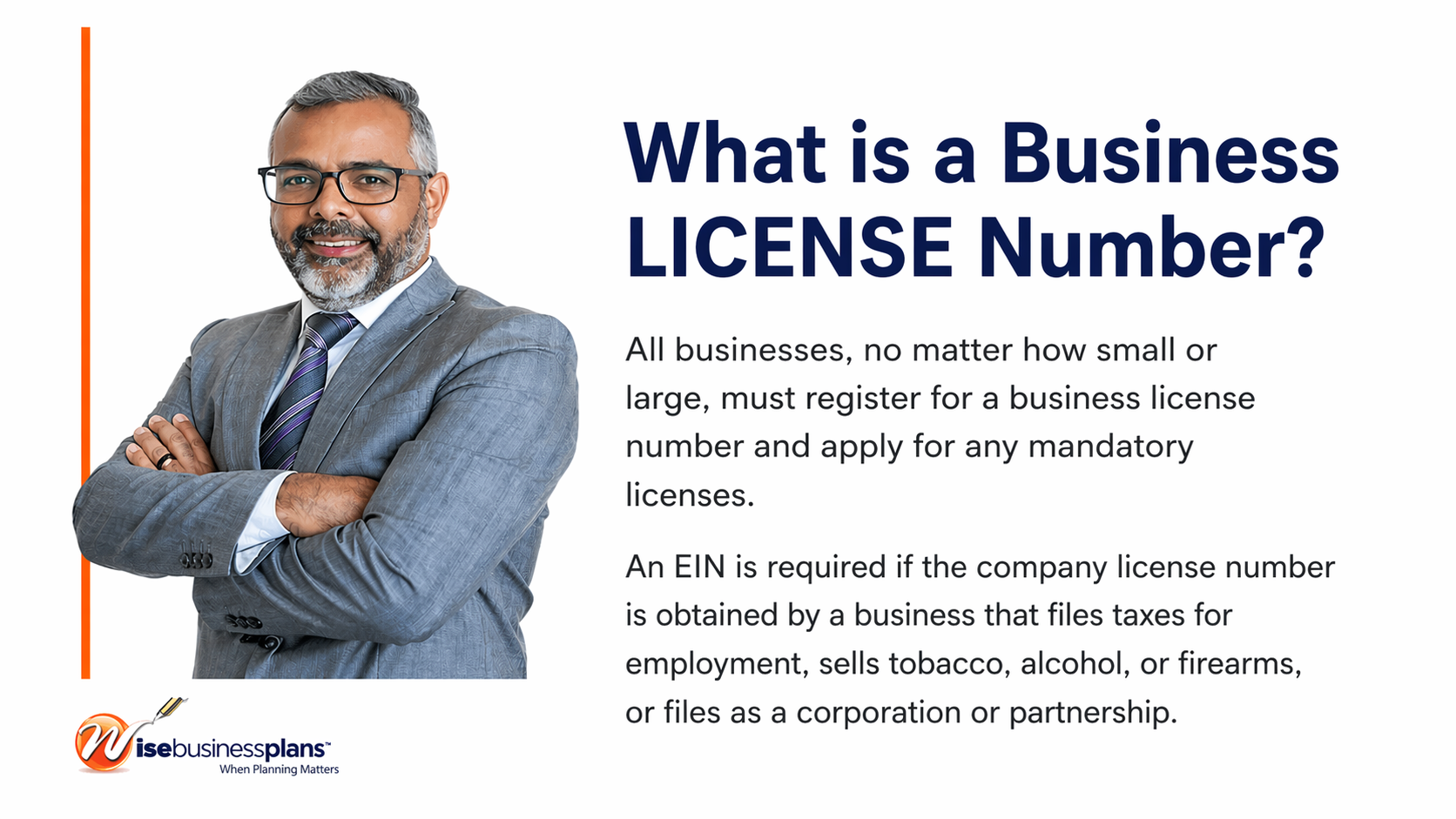
Infographic explaining what a business license number is, showing a professional business consultant alongside a definition covering its purpose and how it differs from an EIN.

Your business license number is your state or city’s official proof that your company is legally allowed to operate. It shows up on your license certificate, permit renewals, tax filings, and increasingly on the paperwork your bank, processor, and B2B customers ask for before they do business with you.

Without a valid one, you can’t open most business bank accounts, you can’t be approved by major payment processors, and most B2B contracts will reject you at the procurement stage. If you’re starting a business, this is one of the first compliance steps you’ll take. This guide walks you through exactly what a business license number is, how to find yours if you already have one, and how to get one if you don’t.

What is a Business License Number?
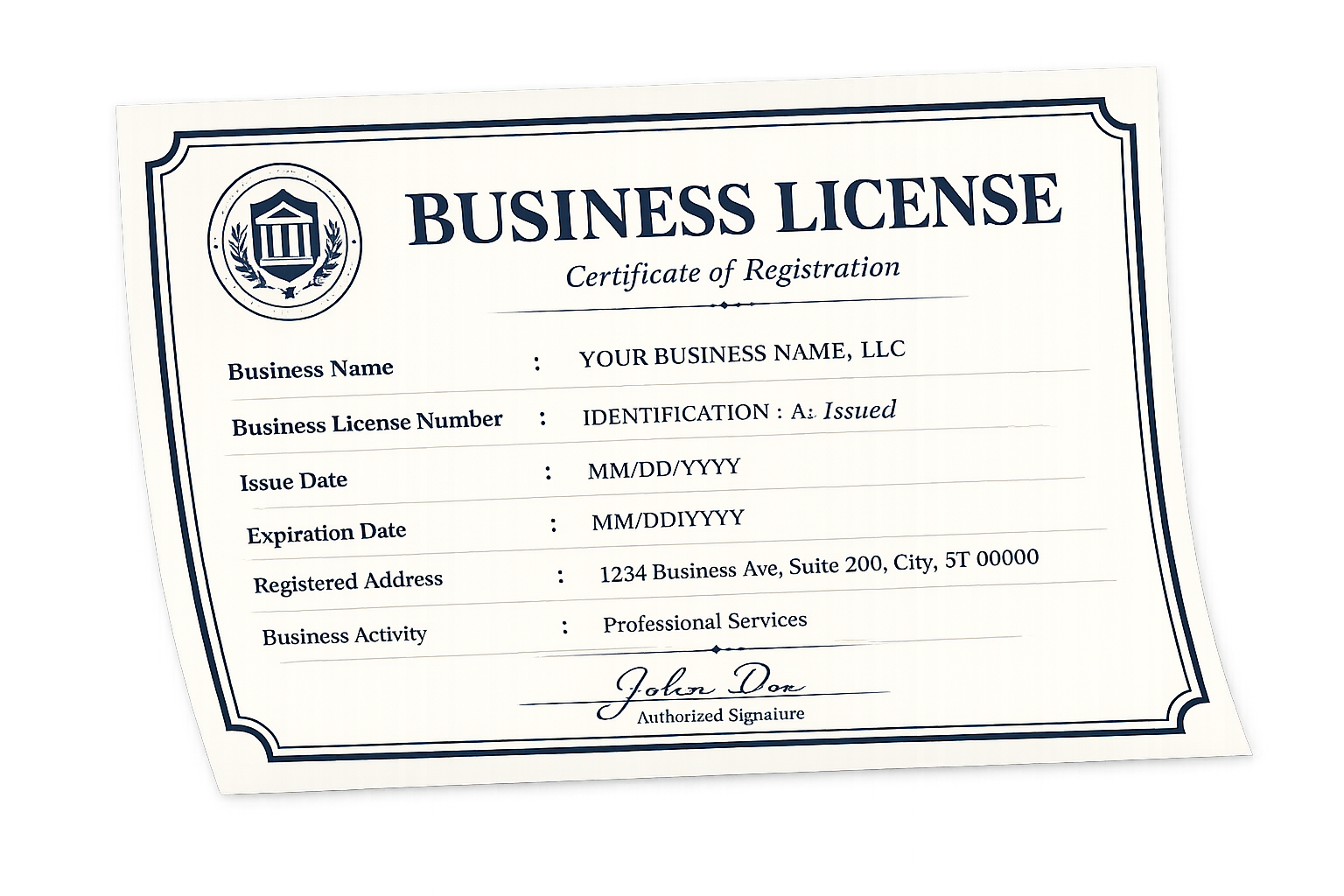
Business license number vs EIN vs state tax ID comparison showing who issues each and what they're used for

A business license number is a unique identifier assigned to your business when a government authority — typically a state, county, or city — grants you permission to operate in their jurisdiction. It’s also called a company license number, a city license number, or a business registration number, depending on where you’re filing.

The number ties your business to a specific license on record. That license might cover your general right to operate, a specific trade (contractor, cosmetologist, food handler), or a regulated activity (selling alcohol, firearms, or tobacco). Every business, regardless of business structure, needs to register with their state and obtain the licenses its jurisdiction requires — and the number is how authorities track compliance.

Keep in mind: the term “business license number” isn’t standardized across the US. In California you’ll see it as a Business Entity Number or LLC/Corporation ID. In Texas it’s referenced by both the SOS File Number and the Comptroller Taxpayer Number. In Florida it’s the Document Number from Sunbiz. Functionally, they all serve the same purpose: proving your business is legally registered.

Why You Need a Business License Number (And What Happens Without One)

A business license number isn’t a bureaucratic formality — it’s the credential that unlocks nearly every operational milestone for a new business:

Banking: Most US banks require a business license number (alongside your EIN and formation documents) before opening a business checking account. Without it, you’re stuck running business finances through a personal account, which creates tax and liability problems.

Payment processing: Stripe, Square, PayPal Business, and nearly every merchant account provider verify your business license number during onboarding. The risk increases sharply without one.

B2B contracts and vendor applications: Procurement teams at larger companies will not sign a vendor agreement without a verifiable business license number on file. Net 30 vendors, wholesale suppliers, and government contracts all require it.

Taxes and filings: State and local tax authorities use your license number to associate sales tax collection, payroll remittances, and annual reports with your business.

Legal protection: Operating without a required license exposes you to fines, back taxes, forced closure, and in some jurisdictions, personal liability for the business owner, even if you’ve incorporated. If you need to get set up properly, we can apply for your business license on your behalf across all 50 states.

Business License Number vs EIN vs State Tax ID: The Key Differences

One of the most common questions new business owners ask is whether a business license number is the same as an EIN. The answer is no, and the difference matters because each number serves a completely different purpose.

Lorem ipsum dolor sit amet, consectetur adipiscing elit. Ut elit tellus, luctus nec ullamcorper mattis, pulvinar dapibus leo.

Identifier Issued By What It’s For When You Need It
Business License Number State, county, or city government Legal authorization to operate in a specific jurisdiction Before you start doing business; specifics vary by location and industry
EIN (Employer Identification Number) IRS (federal) Federal tax filing, payroll, business banking Required if you hire employees, form a corporation or partnership, or sell regulated goods (alcohol, firearms, tobacco)
State Tax ID State tax or revenue department Collecting and remitting state-level sales, use, and payroll taxes Required if you sell taxable goods or services, or have employees in the state

In plain terms: your EIN is your federal tax fingerprint, your state tax ID handles state-level taxes, and your business license number is the permission slip to operate. Most businesses end up needing all three. If you’re just starting out, treat them as three separate steps in your setup checklist — not interchangeable pieces of paperwork.

How to Find Your Business License Number in the Top 10 States

If you’ve already registered your business, your license number is on file with whichever authority issued it. Here’s exactly where to look in the 10 states where most US businesses are formed.
State Official Portal What You Get
California bizfile Online (sos.ca.gov) Entity Number (7-digit older or 12-digit newer)
Texas Comptroller Taxable Entity Search 11-digit Taxpayer Number + SOS File Number
Florida Sunbiz Search (search.sunbiz.org) Document Number
New York NY DOS Corporation Search DOS ID
Pennsylvania PA Business Entity Search Entity Number
Illinois Illinois SOS Corporation/LLC Search File Number
Ohio Ohio SOS Business Search Entity Number
Georgia Georgia Corporations Division Control Number
North Carolina NC SOS Business Search SOS ID
Washington WA DOR Business Lookup UBI (Unified Business Identifier)

California

Search the California Secretary of State’s bizfile Online portal at bizfileOnline.sos.ca.gov. Enter your business name or entity number to pull your Corporation, LLC, or LP record. California assigns a 7-digit number (older entities, prefixed with a letter like C1234567) or a 12-digit number for entities formed after 2001.

Texas

Texas uses two portals. The Comptroller’s Taxable Entity Search returns your 11-digit Taxpayer Number — available at mycpa.cpa.state.tx.us/coa/. The Texas SOSDirect system (sos.state.tx.us) returns your SOS File Number — there’s a $1 search fee. Both are used depending on which filing you’re completing.

Florida

Florida’s Sunbiz portal – search.sunbiz.org – is the official business entity search. Look up your business by entity name, officer name, or FEI number to find your Document Number, which acts as your state business identifier.

New York

Use the NY Department of State Corporation and Business Entity Database at apps.dos.ny.gov/publicInquiry to find your DOS ID — the numeric identifier assigned when your entity was formed. You can search by entity name, DOS ID, or assumed name.

Pennsylvania

Search the PA Department of State Business Entity Search at file.dos.pa.gov. Enter your business name to pull your Entity Number and filing history.

Illinois

The Illinois Secretary of State Corporation/LLC Search (ilsos.gov) returns your File Number by entity name or number. Illinois also requires a separate Certificate of Registration for sales tax purposes issued by the Department of Revenue.

Ohio

Use the Ohio Secretary of State Business Search at businesssearch.ohiosos.gov to find your Entity Number. Vendor’s License numbers (required for retail sales) are issued separately by the Ohio Department of Taxation.

Georgia

Search Georgia’s Corporations Division database at ecorp.sos.ga.gov to find your Control Number. Local business license numbers (Occupational Tax Certificates) are issued separately by your county or city.

North Carolina

The NC Secretary of State Business Registration Search (sosnc.gov) returns your SOS ID. NC also requires a separate Privilege License for certain regulated professions.

Washington

Washington consolidates business licensing under the Department of Revenue Business Lookup at secure.dor.wa.gov/gteunauth. Your Unified Business Identifier (UBI) serves as your primary state business number and covers most licensing across agencies.

If you’re operating in a state not listed here, start at your Secretary of State’s website — every state maintains a public business entity search. For city and county licenses, you’ll typically find the number on the physical certificate you received when the license was issued, or by calling the issuing office directly.
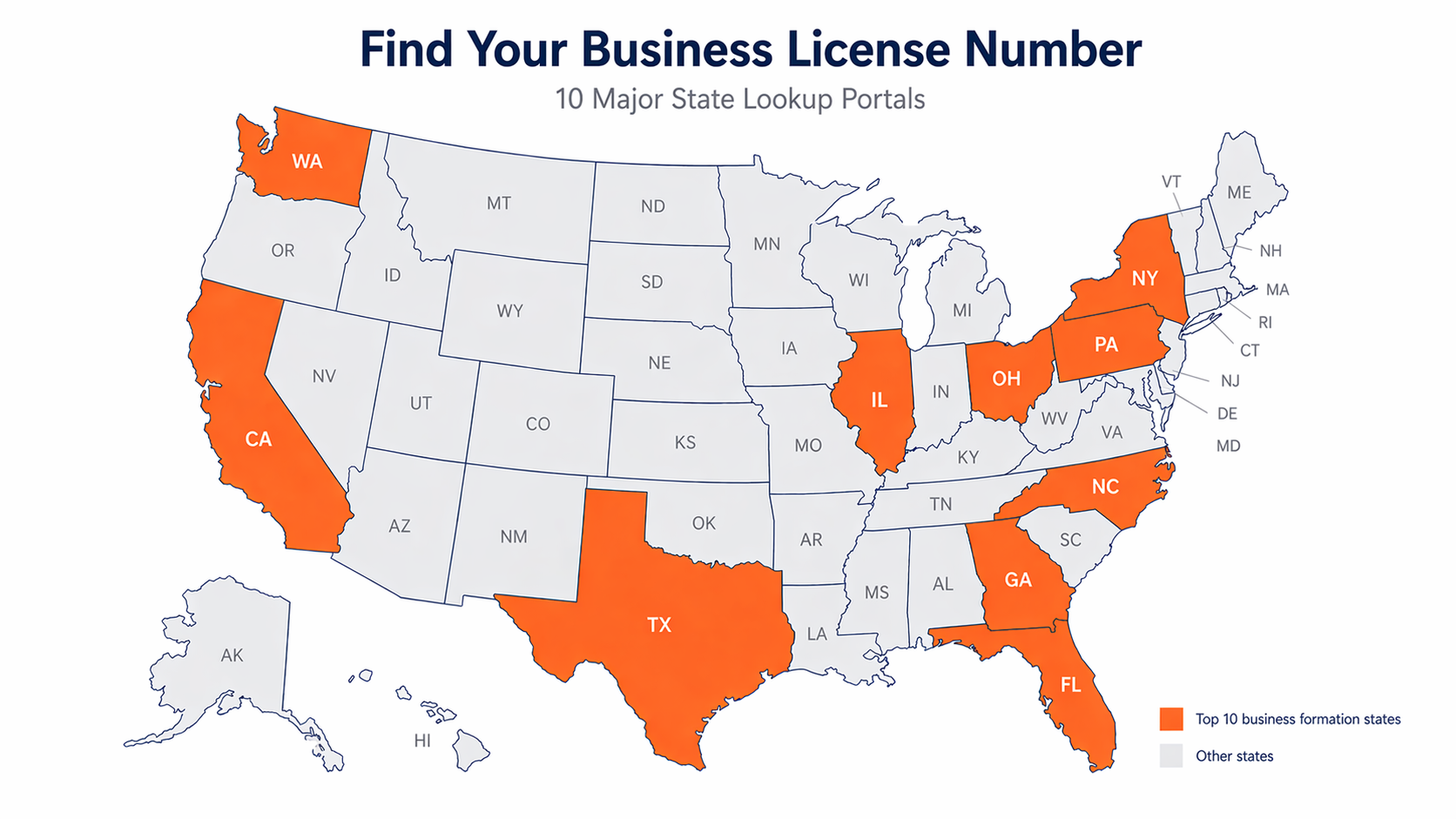
US map highlighting 10 major states with official online portals to look up your business license number, including California, Texas, Florida, New York, Pennsylvania, Illinois, Ohio, Georgia, North Carolina, and Washington.

How to Get a Business License Number (Step by Step)

If you haven’t registered yet, the process follows roughly the same sequence in every state, though the specifics vary. Here’s the standard path:

Step 1: Choose and register your business name. Before applying for any license, your business entity needs to be formed. Start by choosing a unique business name and registering the business name with your state. If you’re operating as an LLC or corporation, file your formation documents with your Secretary of State. Sole proprietors typically register a DBA at the county level.

Step 2: Get your federal EIN. Apply free on the IRS website. You’ll need this for most state and local license applications.

Step 3: Identify which licenses your business needs. This varies by industry, location, and business activity (see our breakdown of different types of business licenses). A retail store in Los Angeles might need a general business license from the city, a seller’s permit from the California Department of Tax and Fee Administration, and a health permit if food is involved. Check your state, county, and city requirements separately — they don’t always overlap.

Step 4: Submit your applications. Most states offer online filing through their Secretary of State or business portal. Cities and counties vary — some accept online filings, others require in-person submission or mail.

Step 5: Receive your license and number. Once approved, you’ll receive an official certificate with your business license number printed on it. Save digital and physical copies — you’ll need this number on nearly every future filing.

If navigating the 50-state landscape sounds overwhelming, it usually is. Our team can handle the full business license application for you, including identifying every license your business actually needs so nothing slips through.

How Much Does a Business License Cost?

Business license costs vary dramatically by state, city, industry, and business size. As a broad range:

State-level business registration (LLC or corporation formation) typically runs $50 to $500. California charges an $800 minimum franchise tax on top of formation fees. General local business licenses (also called business tax certificates in some cities) usually range from $50 to $400 per year for small businesses, scaling with gross revenue in some jurisdictions. Industry-specific licenses — contractor, liquor, food service, firearms, childcare — add their own fees, sometimes substantially, and frequently require bonding or insurance proof.

Your state’s Secretary of State website and the US Small Business Administration both maintain fee guides. Expect to budget for both initial fees and annual renewal costs.

How Long Does It Take to Get a Business License?

Timelines vary by state and license type. Online filings through most state portals return a business license number within 1–5 business days. Paper filings can take 2–6 weeks. Specialty licenses — contractor, healthcare, liquor — often require background checks, examinations, or inspections that extend the timeline to 30–90 days.

Some cities require in-person pickup with photo ID or fingerprinting for retail licenses, particularly in regulated industries. Others mail the certificate directly. Factor licensing timelines into your launch plan — you generally cannot legally transact, open a business bank account, or sign contracts until your license number is issued.

FAQs:

A business license number is a unique identifier assigned to a business by the issuing authority — typically a state, county, or city. It’s used to track and verify that your business has obtained the necessary license to operate legally in that specific jurisdiction.

Your business license number can usually be found on the official license certificate issued by the government or municipal authority. It may also appear on business registration certificates, permits, or tax documents. If you’ve lost the certificate, search your state’s Secretary of State portal or contact the issuing city or county office directly.

A business license number is required to ensure compliance with local laws and regulations. Without one, you generally can’t open a business bank account, be approved by payment processors like Stripe or Square, file state sales tax, or sign most B2B contracts. Operating without the required license can result in fines, back-taxes, and forced closure. If you need to get set up properly, we can apply for your business license through Wise on your behalf.

Operating a business without a valid license number is illegal in most jurisdictions. Penalties range from fines to business closure, and in some cases personal liability for the owner even when the business is incorporated. Always verify your state, county, and city requirements before you start transacting.

No. A business license number is issued by a state or local authority and verifies your legal right to operate. A TIN or EIN is issued by the IRS for federal tax purposes – filing returns, running payroll, and opening business bank accounts. Most businesses need both.

Yes, in most cases. Payment processors (Stripe, Square, PayPal Business), online marketplaces (Amazon, Etsy seller accounts), and state tax filings all require a business license number — even if you have no physical storefront. Your home state typically issues your primary license, though you may also need permits in other states where you have nexus.

Usually not. Most business licenses are tied to the specific owner and entity, not to the business itself. When ownership changes, the new owner generally has to apply for their own license from scratch. Some states allow license transfer for specific industries (liquor licenses, taxi medallions) but the default is non-transferable.

Tags: Business License and Permits, Entity Requirements