
The business landscape moves fast. If you wrote a business plan five years ago, it probably looks like a relic from a different era today. As we look toward 2026, the traditional static document—a 40-page text file that sits in a drawer gathering dust—is officially dead.
Investors and stakeholders now demand dynamic, resilient strategies that can withstand global shocks and technological shifts. The old “set it and forget it” model of five-year forecasting is being replaced by agile frameworks that prioritize adaptability and responsibility.
If you are drafting a roadmap for the future, you need to know what the new standards are. Here are the top trends shaping business plans in 2026 and how they are redefining what it means to be “investor-ready.”
1. Scenario Planning Replaces Linear Forecasting
For decades, the standard financial model involved a “hockey stick” growth curve: slow growth in year one, followed by explosive, uninterrupted success in years three through five.
In 2026, this kind of linear optimism is seen as naive. After a global pandemic, supply chain collapses, and rapid inflation, investors know that the future is rarely a straight line.
What is Scenario Planning?
Instead of presenting one single future, modern business plans now include Scenario Planning. This involves creating three distinct financial and operational models:
- The Base Case: The most likely outcome based on current trends.
- The Bear Case (Downside): A survival strategy for if things go wrong (e.g., a recession hits, a key supplier fails, or a new competitor enters the market).
- The Bull Case (Upside): A growth strategy for if the product goes viral or market adoption accelerates faster than expected.
Why It Matters
Investors want to know that you have a “Plan B.” Showing that you have thought about how to cut costs during a downturn without firing your core team builds more trust than showing a chart where revenue only goes up. It proves resilience.
2. ESG Integration is No Longer Optional
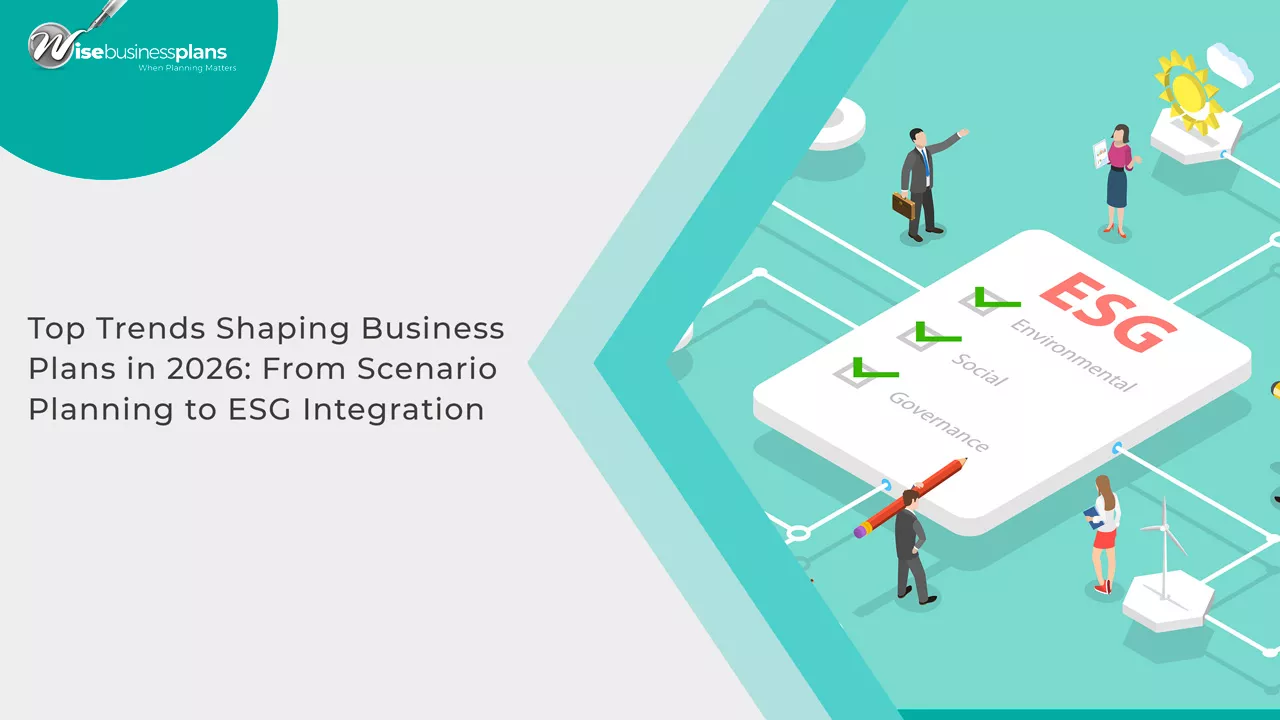
A few years ago, a section on Environmental, Social, and Governance (ESG) was a “nice-to-have” bonus for impact startups. In 2026, it is becoming a baseline requirement for businesses of all sizes.
Capital is moving toward responsibility. Banks, venture capitalists, and even grant committees are under pressure to deploy funds into companies that are not liabilities to the planet or society.
Moving Beyond “Greenwashing”
It is not enough to simply say, “We recycle.” The 2026 business plan requires concrete metrics:
- Environmental: How are you measuring your carbon footprint? Is your supply chain sustainable? Do you have a plan for waste reduction?
- Social: What are your diversity and inclusion hiring practices? How do you ensure fair labor practices in your manufacturing?
- Governance: How transparent is your leadership? Do you have checks and balances in place to prevent fraud?
Integrating ESG isn’t just about saving the world; it’s about risk management. Companies with poor governance or environmental practices are now seen as high-risk investments.
3. The Rise of "Living" Business Plans
The days of the PDF are numbered. We are seeing a shift toward “Living Business Plans”—digital, cloud-based documents that are updated in real-time.
Dynamic Data Integration
Advanced business planning software now links directly to accounting tools like QuickBooks or Xero. This means the “financials” section of your plan isn’t a static guess from six months ago; it reflects your actual cash flow from yesterday.
For entrepreneurs, this trend means the business plan becomes a daily operational dashboard rather than a fundraising hurdle. It allows founders to pivot strategies instantly based on real data rather than waiting for a quarterly review.
4. AI and Advanced Analytics as a Co-Pilot
While AI cannot replace the founder’s vision (as we’ve discussed in previous posts), it is becoming an indispensable tool for supporting that vision with data.
In 2026, business plans utilize AI for:
- Hyper-Local Market Analysis: Instead of general industry stats, AI can scrape data to tell you exactly how many potential customers live within a 5-mile radius of your proposed storefront.
- Predictive Analytics: AI tools help model customer churn rates and lifetime value with much higher accuracy than manual spreadsheets.
- Competitive Intelligence: AI can monitor competitor pricing and marketing strategies in real-time, allowing your business plan to address specific threats dynamically.
The key trend here is Human + AI. Investors look for plans where AI provides the data, but human insight provides the strategy.
5. Focus on Unit Economics Over "Growth at All Costs"
The era of “blitzscaling”—burning massive amounts of cash to grow user count regardless of profit—has ended. The 2026 business plan focuses intensely on Unit Economics.
Investors are asking one simple question: “Can you make a profit on a single sale?”
If it costs you $50 to acquire a customer who only spends $40, you don’t have a business; you have a hobby. Modern plans prioritize:
- Profitability timelines: How quickly can you get to break-even?
- CAC vs. LTV: A clear demonstration that the Lifetime Value (LTV) of a customer is significantly higher than the Cost to Acquire (CAC) them.
- Operational Efficiency: Detailed plans on how to do more with less capital.
6. The "Talent Strategy" Section Gets an Upgrade
With the rise of remote work and the gig economy, the “Team” section of a business plan has evolved. It is no longer just a list of resumes.
Investors want to see a Talent Strategy. This includes:
- Remote vs. Hybrid Models: How will you build culture if your team is distributed globally?
- Retention Plans: In a competitive labor market, how will you keep your best people?
- The “Fractional” C-Suite: Many startups in 2026 are using fractional CFOs or CMOs to keep costs low while accessing high-level expertise. Explaining this structure in your plan shows financial maturity.
As these trends accelerate, working with an experienced business plan writer helps ensure financial models, risk scenarios, and assumptions are aligned with how lenders and investors now evaluate plans
Conclusion
The business plan of 2026 is smarter, leaner, and more honest than its predecessors. It embraces uncertainty through scenario planning, commits to responsibility through ESG, and leverages technology without losing the human touch.
If you are still using a template from 2015, you are already behind. To secure funding in this new landscape, your plan needs to be as forward-thinking as your business idea.
Don’t let an outdated plan hold you back. Wisebusinessplans specializes in creating modern, trend-aligned business plans that speak the language of today’s investors. From complex financial modeling to ESG integration, we build roadmaps that get funded. Contact us today to future-proof your business strategy.